


Article: Where do jeans come from?
Where do jeans come from?
Jeans: The Garment That Endures Through Time... and Fashion
Jeans, denim, dungarees... these are just a few of the names given to the most successful clothing item of recent decades, the only one to have endured for 6 generations almost unchanged and without losing its essence. It has dressed workers, the wealthy and the poor, rebels, movie stars, the modern and the classic, young and old alike. No one has been able to resist them, and people today continue to succumb to their unique and timeless charm.

Origins of Jeans
Its origin is not without controversy—which is only natural, as when something achieves success on such a massive scale, there is no shortage of claimants to its creation. In this case, Americans, the French, and Italians all contend for the credit. Back in 1853, in the midst of the Gold Rush and the construction of North America's railways, there was a desperate need for durable clothing.
America was a prosperous and booming country where everything was yet to be built, and farmers, miners, ranchers (cowboys), railway workers, and others needed clothing that could withstand heavy daily use.
Levi Strauss Turned Tents into Work Overalls
German-born Levi Strauss opened a tent canvas business in San Francisco designed to serve miners. Upon realizing that miners preferred sleeping under the stars and actually needed tough, durable pants, he decided to use the sturdy canvas fabric from the tents to manufacture work overalls. For this reason, these garments were originally brown.
Later, in 1873, Strauss partnered with a tailor named Jacob Davis, who came up with the idea of reinforcing the pants with copper rivets at weak points where they frequently tore. This definitively gave birth to the very first pair of Jeans.
Americans, the French, and Italians Dispute the Credit
It was only later that jeans began to be manufactured in the characteristic blue color we know today. This color traces its origins back to the Italian city of Genoa (or Genes). Fishermen in this city dyed their fabrics with an indigo pigment sourced from India.
English ships would dock at the port of Genoa and load up on the fabric known as "Bleu de Gênes" (Genoa Blue) to export to America. That is precisely where the word "Jeans" comes from.
The French version argues that this heavy, durable fabric used to make boat sails and sailors' pants—which inspired Levi Strauss's jeans—was actually produced in the French city of Nîmes and called "Serge de Nîmes," which eventually evolved into Denim. What is certain is that, one way or another, the roots of the fabric lie in the Mediterranean, but the credit for creating jeans as a garment belongs to Levi Strauss and Jacob Davis in America.
Jeans and Denim: Current Usage of the Terms
Today, the term "jeans" is used for the garment itself, whereas "denim" refers to both the garment and the indigo fabric from which it is crafted.
Jeans as a Cultural Icon
The global success of this garment arrived in the 1960s thanks to the film industry. Icons like James Dean and Marlon Brando, symbols of youth rebellion, linked the image of jeans directly to their lifestyle.
By the 1970s, jeans had become an iconic, universal garment that crossed boundaries of gender, class, and race.
In the 1980s, jeans made their mark in the fashion world, giving rise to distinct wash treatments and far more intricate effects that imparted unique individual characteristics to each piece.
Jeans, Youth, and Sports
Throughout its recent history, jeans (and denim) have always been tied to youth movements and cultural trends like cinema, music, dance, urban subcultures, and even action sports such as skateboarding, biking, and climbing—as an increasing number of enthusiasts search specifically for climbing jeans.

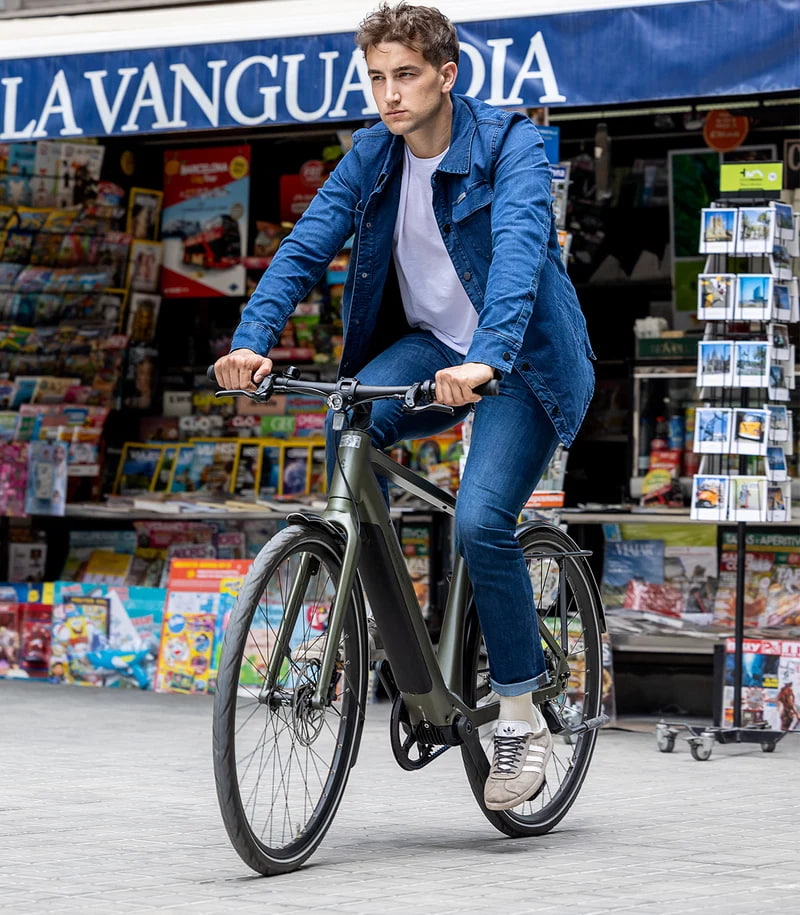
Blue jeans for urban cycling - Berlin.
At JeansTrack, we are genuinely passionate about denim jeans—some of us have been professionally dedicated to it for over 25 years. We have now combined that expertise with another of our great passions, sports, to launch this activewear brand.


Leave a comment
This site is protected by hCaptcha and the hCaptcha Privacy Policy and Terms of Service apply.